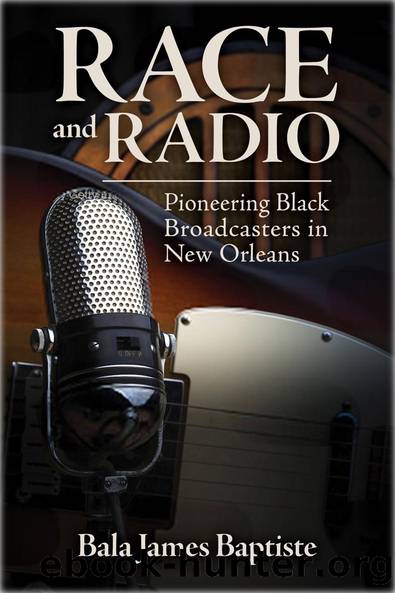
Race and Radio by Bala James Baptiste
Author:Bala James Baptiste [Baptiste, Bala James]
Language: eng
Format: epub
Tags: Social Science, Ethnic Studies, American, African American & Black Studies, Performing Arts, Radio, History & Criticism, History, United States, State & Local, South (AL; AR; FL; GA; KY; LA; MS; NC; SC; TN; VA; WV), Media Studies
ISBN: 9781496822086
Google: RwSiDwAAQBAJ
Publisher: Univ. Press of Mississippi
Published: 2019-08-01T03:52:44+00:00
CHAPTER FIVE
The Pioneer Mixed a âBatch of âCongratsââ
In December 1949 Vernon Winslow, in his Dr. Daddy-O column âBoogie-beat Jive,â published once a week in the Louisiana Weekly, hinted an âentirely coloredâ radio station would broadcast in New Orleans and a second station would employ some âcolored announcersâ along with âofay management.â1
As white listeners migrated to television as it transitioned into the dominant player in broadcasting in postâWorld War II America, radio stations not network-affiliated increasingly sought black audiences. Similarly, to attract African Americans, between 1948 and 1952 new radio broadcasters increasingly aired programming including the music genres rhythm and blues, gospel, jazz, and traditional blues. They began employing black talent, scheduling black entertainment programs, broadcasting African American talk shows, and advertising the services and products of black entrepreneurs. The options presented themselves clearly. Independents either targeted a nontraditional audience or went out of business.2
Drastic conversion in the color of radio in New Orleans was about to unfold in the winter of 1949, when new licensee WMRY began broadcasting from the Court of Two Sisters restaurant at 615 Bourbon Street in the French Quarter. The station, on the property of one of the most elegant white courtyard eating establishments in the city, targeted Caucasians and was failing financially. General manager Mort Silverman had to take his station in another direction. WJBW, as early as 1946, broadcast live music performances from the black Dew Drop Inn nightclub. Silverman hired WJBWâs program director Jim Warren. At the time, two additional local stations aired shows targeting African Americans. WJMR had âJam, Jive & Gumbo,â a recorded music show featuring white disc jockeys playing race music and trying to mimic black street-talk. Vernon Winslow trained most of them. WWEZ was the other station broadcasting African American music. Its singular show, âJivin with Jax,â hosted by Winslow, propelled him to fame. The appointment placed Winslow as the cityâs first full-time African American deejay, aka Dr. Daddy-O.3
After only three months on the air, on March 4, 1950, WMRY brought listeners Ernest Bringier and his daily black music record show, âTan Timers Club.â Bringier became the cityâs second full-time African American disc jockey. Days later, Silverman hired another African American, George âTexâ Stephens, who assumed the name âMr. Cool,â and hosted âTippinâ with Tex,â a daily midday show featuring mellow tunes.4 Bringier and Stephens were not simply disc spinners. They were brought in to attract black listeners, advertisers and, subsequently more revenue. Stephens, for example, was affiliated with Caire Associates, an advertising and sales promotion agency.5 Four months later, Silverman moved his station from Bourbon Street to the black-owned Louisiana Industrial Life Insurance Company building, 2107 Dryades Street, approximately one block from the Dryades YMCA, in the heart of a working-class African American community. On May 28, WMRY began fully broadcasting from Dryades Street.6 Silverman said, âBefore 1950 we were featuring good music and failing. May 28th of that year we switched to a solid Negro format. In a month we paid our way, and revenue has increased steadily ever since.
Download
This site does not store any files on its server. We only index and link to content provided by other sites. Please contact the content providers to delete copyright contents if any and email us, we'll remove relevant links or contents immediately.
| Anthropology | Archaeology |
| Philosophy | Politics & Government |
| Social Sciences | Sociology |
| Women's Studies |
Cecilia; Or, Memoirs of an Heiress — Volume 1 by Fanny Burney(32636)
The Great Music City by Andrea Baker(32609)
Cecilia; Or, Memoirs of an Heiress — Volume 2 by Fanny Burney(32010)
Cecilia; Or, Memoirs of an Heiress — Volume 3 by Fanny Burney(31996)
We're Going to Need More Wine by Gabrielle Union(19108)
All the Missing Girls by Megan Miranda(16313)
Pimp by Iceberg Slim(14664)
For the Love of Europe by Rick Steves(14563)
Bombshells: Glamour Girls of a Lifetime by Sullivan Steve(14136)
Norse Mythology by Gaiman Neil(13457)
Talking to Strangers by Malcolm Gladwell(13439)
Fifty Shades Freed by E L James(13289)
Mindhunter: Inside the FBI's Elite Serial Crime Unit by John E. Douglas & Mark Olshaker(9419)
Crazy Rich Asians by Kevin Kwan(9345)
The Lost Art of Listening by Michael P. Nichols(7547)
Enlightenment Now: The Case for Reason, Science, Humanism, and Progress by Steven Pinker(7354)
The Four Agreements by Don Miguel Ruiz(6831)
Bad Blood by John Carreyrou(6669)
Weapons of Math Destruction by Cathy O'Neil(6362)
